Burst Pipe Cleanup in Englewood, CO
A split supply line can put hundreds of gallons into a house before anyone sees it. The extraction crew pulls the water, follows it into the walls and ceilings with meters and dries every cavity it reached.
(888) 532-8620Pipe let go? Get the water out- Cavity drying
- Thermal imaging
- Timestamped photos
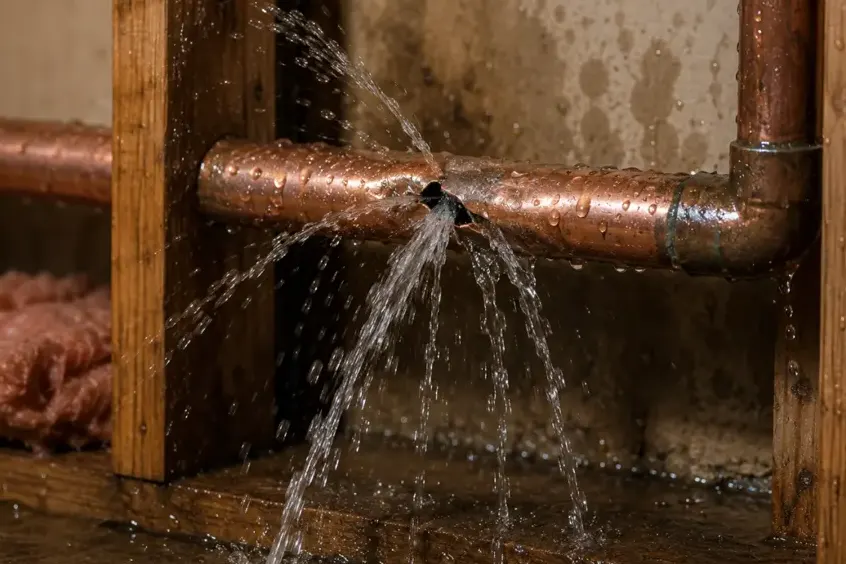
What to do the moment a pipe bursts
- Close the main valve; in many Englewood homes it sits low on the basement wall facing the street.
- Open a faucet on the lowest level to drain the pressure out of the lines.
- Turn off breakers for wet rooms if the panel is dry and safe to reach.
- Photograph the broken pipe and the water before cleanup begins.
- Call a plumber for the pipe and the extraction crew for the water.
How burst pipe cleanup is handled right
Follow the water
Water runs down stud bays and across the top of the ceiling below. Thermal imaging and pinless meters show where it went.
Open only what is wet
Small drill holes let dry air into a cavity; flood cuts are made only where drywall or plaster is too wet to save.
Dry the framing
Cavity drying systems, air movers and LGR dehumidifiers run until the studs and plates reach the drying goal.
What does burst pipe cleanup cost in Englewood, CO?
In Englewood, CO, burst pipe water cleanup typically runs $1,000 to $7,000, not counting the plumbing repair. The price follows the gallons released, how many rooms and levels got wet, whether ceilings are involved and how long the water sat.
For a closer planning number, run the water damage cost calculator. The restoration contractor who responds sets the real scope after the walkthrough and the moisture map.
How burst pipe cleanup is handled in Englewood
- 01
Confirm it is off
The response team checks that the main is closed and the line drained so no new water arrives.
- 02
Trace the path
Thermal imaging and meters follow the water down cavities and across the ceiling below.
- 03
Extract and open
The extraction crew pulls standing water and opens cavities only where readings show saturation.
- 04
Dry the cavities
Air movers and LGR dehumidifiers run until framing reaches the drying goal.
Why pipes burst in Englewood houses
Englewood's housing stock spans a century, and the plumbing shows it. The failures that come up most:
- Galvanized steel supply lines in pre-1960s homes that rust shut and split at the threads
- Polybutylene lines in some homes built roughly 1978 to 1995, which crack at fittings
- Copper in an exterior wall or crawlspace that freezes during an Arctic front and splits on the thaw (see frozen pipe cleanup)
- Old compression fittings and shutoff valves under sinks and toilets that finally let go
Water inside walls and plaster
A burst line upstairs sends water down the stud bay and across the top of the ceiling below. From the room it looks like a stain. Inside, the insulation is soaked and the bottom plate is wet. Plaster on wood lath, common in Englewood's older homes, holds water longer than drywall and can lose its grip on the lath when it stays wet. The mitigation team finds the water with meters, then either drills small holes to push dry air into the cavity or opens the wall where the material is too wet to save.
Ceilings that sag are opened first, because trapped water can bring a panel down. If the ceiling below took water, see ceiling leak water damage.
Documentation for the claim
A burst pipe is the textbook sudden and accidental discharge. The claim file usually carries photos of the failed pipe, a moisture map from day one, daily readings and the plumber's invoice. EPA WaterSense covers how to spot slow leaks early, and Ready.gov winter weather covers protecting pipes before a cold snap.
Other water damage services in Englewood
Water damage help across Englewood, CO
The Englewood restoration crew covers every Englewood neighborhood from Downtown and South Broadway to Arapahoe Acres and Kent Place, plus Sheridan, Cherry Hills Village, Greenwood Village and Centennial next door.
ZIP codes 80110, 80111, 80112, 80113, 80150, 80151 and 80155.
See every Englewood area coveredBurst pipe cleanup questions
Who fixes the pipe, and who handles the water?
A plumber repairs the pipe. The restoration crew handles extraction, drying and the moisture documentation. Drying can start as soon as the water is shut off, even before the repair is finished.
Do the walls have to be torn open?
Not always. When readings show the cavity is wet but the drywall or plaster is sound, small holes and cavity drying can dry it in place. Walls are opened where the material is saturated or sagging.
How long does it take to dry after a burst pipe?
A contained loss usually dries in three to five days. Plaster, hardwood and two-level losses take longer.
Is a burst pipe covered by insurance?
A sudden burst is commonly covered under the water damage part of a homeowners policy, after the deductible. Slow leaks and wear are often excluded. Coverage depends on your policy, so it is worth checking with your own insurer.
Should the galvanized pipe be replaced?
That is a plumbing decision, but when one galvanized section bursts, the rest of the run is usually the same age. Many homeowners repipe during the rebuild, while walls are already open.
Can the hardwood floor be saved?
Often, if drying starts quickly. Drying mats pull water up through the boards; cupping usually settles as the wood dries. Boards that stay swollen or buckle are replaced.
Burst pipe in Englewood? Call now.
Extraction, cavity tracing and structural drying for split supply lines, any hour.
(888) 532-8620Split line in Englewood? Dial nowWater Damage Englewood CO
Englewood, CO and nearby Arapahoe County
(888) 532-8620 · open 24/7
Water and sewage losses only
Find us on Google